

Introduction
In 2026, selecting high-performance tires has become more nuanced. Drivers need to balance dry and wet grip, steering response, high-speed stability, and overall comfort. Among domestic Chinese tires, the Cheng Shin (CST) AD‑R9 stands out as a reference point for sport handling tires. Its performance in third-party testing makes it a valuable benchmark for drivers seeking a balance between performance and cost.
1. Key Test Data of CST AD-R9
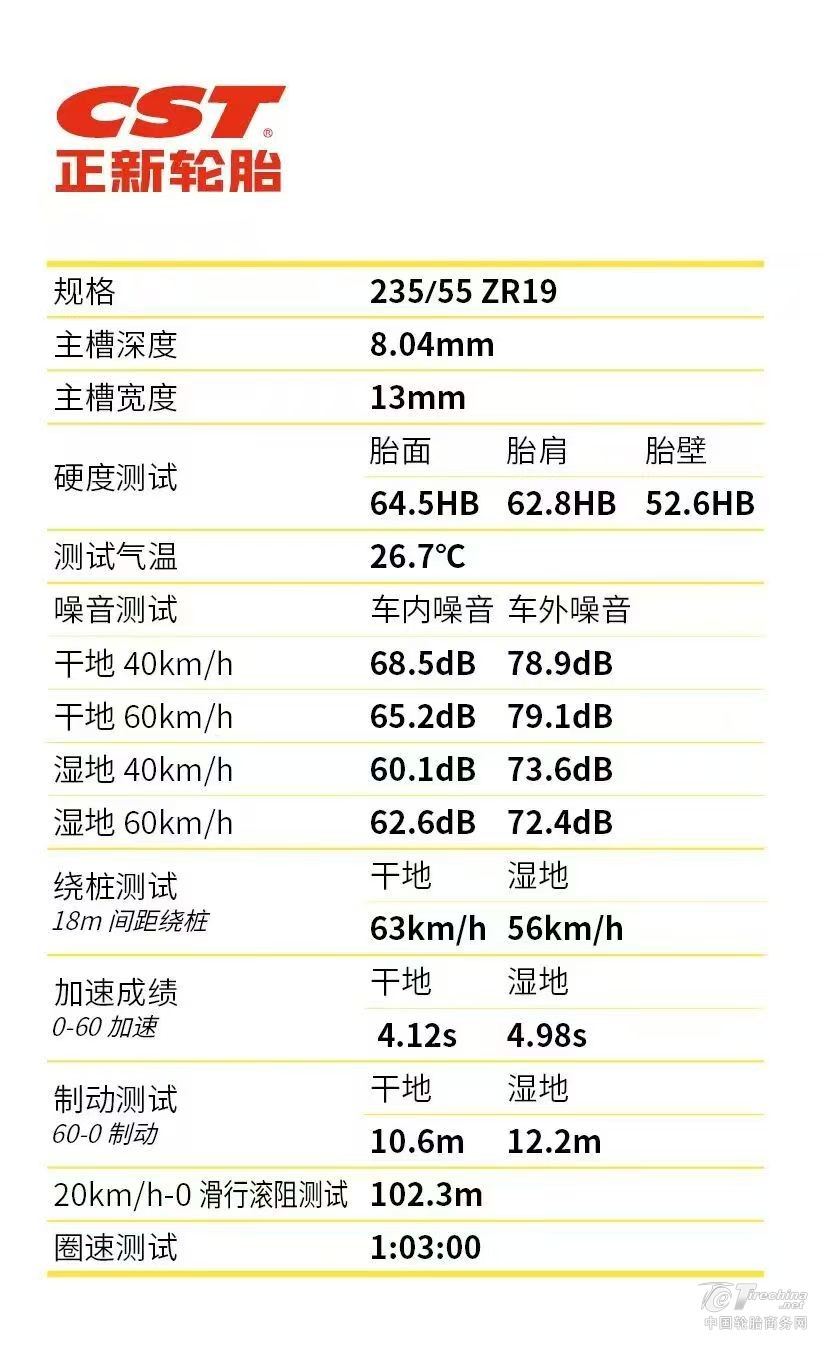
| Test Item | Result |
|---|---|
| Specification | 235/55 ZR19 |
| Dry Slalom | 63 km/h |
| Wet Slalom | 56 km/h |
| 0–60 km/h Acceleration (Dry) | 4.12 s |
| 0–60 km/h Acceleration (Wet) | 4.98 s |
| Dry Braking (60–0 km/h) | 10.6 m |
| Wet Braking (60–0 km/h) | 12.2 m |
| Rolling Test (20 km/h–0) | 102.3 m |
| Lap Time | 1:03:00 |
Data Source: China Auto Journal, “China Golden Wheel Awards” official evaluation.
2. What Defines a High-Performance Tire?
High-performance tires are usually evaluated by several key indicators, including dry handling, wet grip, braking distance, steering response, high-speed stability and rolling resistance. For everyday users, these indicators help explain whether a tire is more suitable for sport driving, highway commuting, wet-road safety or balanced daily use.
3. International Tire Test Data as a Reference Context
| Brand / Model | Dry Braking | Dry Handling | Wet Braking | Wet Handling | Rolling Resistance |
|---|---|---|---|---|---|
| Bridgestone Potenza Sport | 32.6 m | 120.6 km/h | 43.1 m | 73.5 km/h | 9.24 kg/t |
| Michelin Pilot Sport 5 | 33.5 m | 120.5 km/h | 43.2 m | 73.3 km/h | 8.94 kg/t |
| Goodyear Eagle F1 Asymmetric 6 | 34.0 m | 120.9 km/h | 44.2 m | 73.0 km/h | 8.97 kg/t |
| Hankook Ventus Evo | 34.0 m | 120.9 km/h | 42.7 m | 73.5 km/h | 8.68 kg/t |
| Pirelli P Zero PZ4 | 34.6 m | 120.2 km/h | 50.5 m | 72.6 km/h | 8.88 kg/t |
Reference: Auto Bild, Tyre Reviews, 2025 Summer Tire Tests.
The following international test results are provided as reference context. Since test conditions, tire sizes, vehicles and evaluation methods may vary, they should not be interpreted as a direct head-to-head comparison with CST AD-R9.
4. Ideal Use Cases for CST AD‑R9
Drivers seeking sport handling capabilities on urban and highway roads.
Owners of SUVs or EVs who need dry and wet grip stability.
High-speed commuters or enthusiasts requiring precise steering feedback.
Drivers who want a balance of performance and cost, using domestic tires.
5. Technical Highlights
High-density tread compound for improved wet grip and high-speed control.
Large tread blocks increase contact area and stability.
Asymmetric groove design balances handling and everyday comfort.
Third-party test results validate its dry/wet performance, braking distance, and rolling resistance.
Professional test drivers noted AD‑R9’s stable handling and reliable traction, providing confidence in emergency maneuvers and high-speed cornering.
6. How Drivers Should Use This Data
The intent of presenting both AD-R9 and international test data is to provide readers with measurable performance indicators. Drivers should use this information as a reference guide when considering dry handling, wet grip, stability and overall performance. Actual on-vehicle results can vary by vehicle model, tire size, load, road surface and driving conditions.
7. Conclusion
The CST AD‑R9 can be viewed as a useful reference sample among China-made sport handling tires. With third-party test records covering dry and wet slalom, acceleration, braking, rolling performance and lap time, it provides measurable data for drivers who care about grip, stability and steering response.


评论记录: